

Solar Rooftop Subsidy Scheme 2025 Gives Free 300 Units Electricity and ₹78,000 Subsidy with Easy Online Application
The Solar Rooftop Subsidy Scheme 2025 is one of the best government initiatives for reducing electricity bills and promoting clean energy. Under this scheme, households can get up to ₹78,000 subsidy and enjoy around 300 units of free electricity every month. The process is simple, and the entire application can be submitted online through the official portal. Once approved, you can install a rooftop solar system from registered vendors and start saving instantly. This scheme is perfect for families looking to cut monthly expenses, become energy independent, and support India’s green energy mission in an affordable way.
Up to ₹78,000 Subsidy for Rooftop Solar Systems
The government provides financial support of up to ₹78,000 depending on the system size. A 1kW system gets ₹30,000 subsidy, 2kW receives ₹60,000, and 3kW or above gets the full ₹78,000. This subsidy directly reduces installation cost, making solar power affordable for middle-class families. The subsidy amount is transferred straight to the beneficiary’s bank account through DBT, ensuring transparency. With this support, even a basic household can switch to solar energy without worrying about high upfront cost.
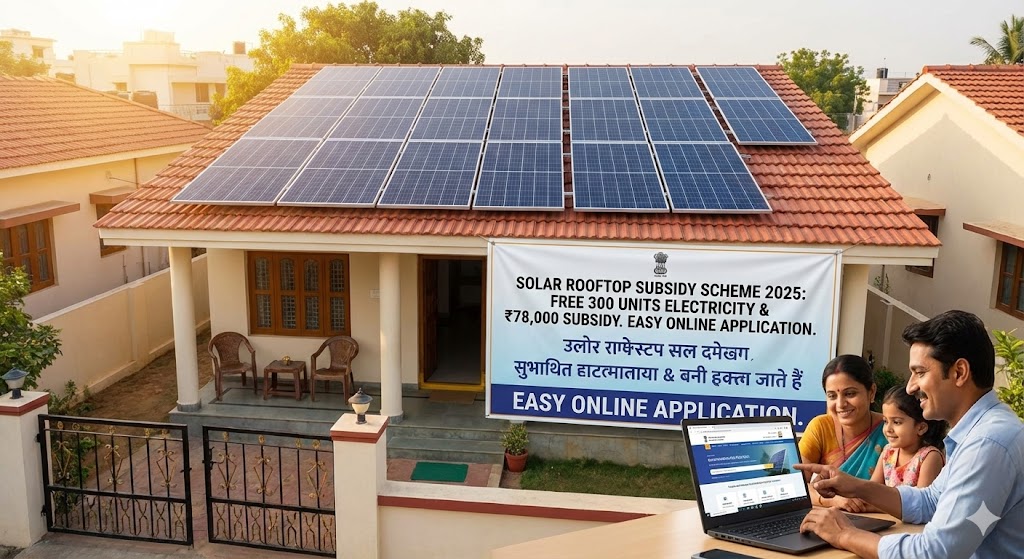
300 Units Free Electricity Every Month
Once the rooftop solar system is installed, families can generate their own electricity and enjoy around 300 free units monthly. This reduces or even eliminates electricity bills. Many households end up paying almost zero bills due to net metering, where extra power generated is sent back to the grid. This benefit is especially helpful for families with high electricity consumption due to ACs, fridges, coolers, and home appliances.
Simple Online Application Process
The application process is completely online through the official portal pmsuryaghar.gov.in. Users just need to register using their mobile number, choose their state and DISCOM, and upload basic documents. After approval, a registered vendor installs the system, followed by DISCOM inspection and meter installation. The online system ensures hassle-free processing without multiple visits to any office.
Eligibility and Required Documents
Any Indian household with a valid electricity connection in the owner’s name is eligible. The rooftop must have enough open space and sunlight. Required documents include Aadhaar, electricity bill, bank details, photo, and property proof. The eligibility criteria are simple, ensuring almost every residential household can benefit from the subsidy.
Long-Term Savings and Zero Maintenance
Rooftop solar reduces electricity bills for 20–25 years, giving long-term financial relief. Most vendors provide up to 5 years of free maintenance, ensuring smooth performance. With rising electricity rates every year, solar panels help families stay tension-free. Along with savings, you also contribute to clean energy, reducing pollution and supporting India’s green future.
Solar Rooftop Subsidy Scheme 2025: Free 300 Units of Electricity and ₹78,000 Subsidy — Here’s The Real Deal
If your electricity bill has been burning a hole in your pocket faster than summer heat in Delhi, there’s finally good news. The government’s new Solar Rooftop Subsidy Scheme 2025 is here, and it’s honestly one of those rare things that feels too good but might actually be true.
Picture this: getting free 300 units of electricity every month and up to ₹78,000 directly as subsidy, all while cutting down power costs and contributing to a greener planet. And get this — you can apply online in less than 15 minutes!
Sounds like a scam WhatsApp forward, right? But nope, this one’s official. Let’s break it down like a friend who’s done all the research for you — minus the confusing government jargon.
Let’s dive in.
What Is the Solar Rooftop Subsidy Scheme 2025?
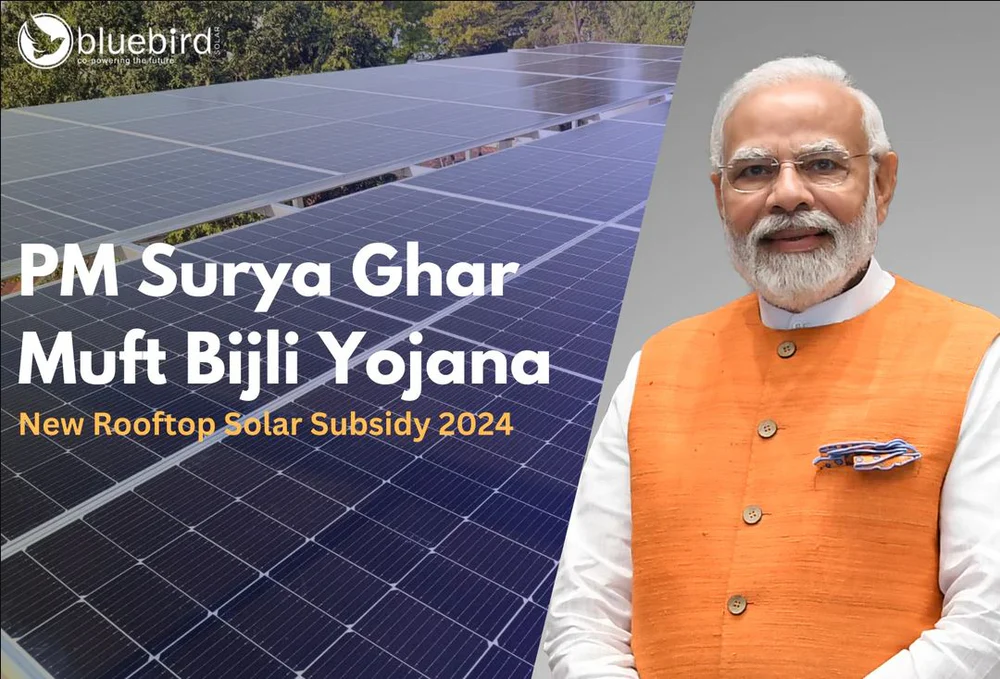
The Rooftop Solar Scheme 2025, also known as the PM Surya Ghar Muft Bijli Yojana, is a Central Government initiative under the Ministry of New and Renewable Energy (MNRE).
Its mission is simple:
“Encourage common households to install solar panels on rooftops and generate their own electricity.”
In exchange, the government covers a large part of the installation cost through subsidy — making solar energy accessible to middle-class households instead of just fancy villas.
Think of it like the government saying, “You bring your roof, we’ll bring the sunlight — let’s share the savings!”
The Big Promise: Free 300 Units of Electricity Every Month
Here’s the headline promise everyone’s talking about:
If you install rooftop solar panels under this scheme, you’ll get up to 300 units of electricity absolutely free each month.
What that means in plain terms:

-
If your home’s average monthly consumption is below 300 units, you could practically pay zero electricity bill.
-
Producing more power than you consume? You might even earn credits from the power company through net metering.
Honestly, for an average Indian household paying ₹1,000–₹2,000 a month in electric bills, that’s a game-changer.
The Subsidy: Up to ₹78,000 Straight From the Government
Now to the juicy part — how much money do you actually save upfront?
The subsidy amount was revised under the PM Surya Ghar Muft Bijli Yojana 2025, and here’s the breakdown (approximate figures):
| Rooftop Solar Capacity | Approx Power Output | Central Govt Subsidy (₹) |
|---|---|---|
| 1 kW system | 110–130 units/month | ₹30,000 |
| 2 kW system | 220–260 units/month | ₹60,000 |
| 3 kW or above | 300–400 units/month | ₹78,000 (maximum subsidy) |
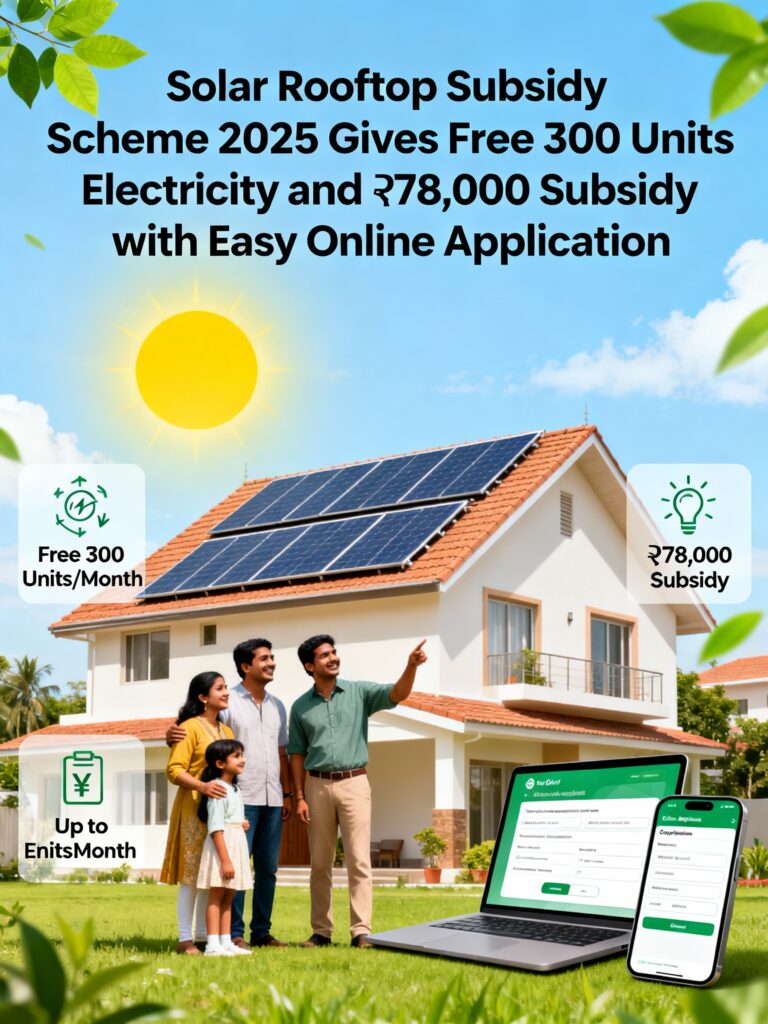
So, for most homes, a 3 kW system is the sweet spot — enough to cover household usage plus occasional AC and appliance load.
By the way, that ₹78,000 is not a discount, it’s a direct subsidy that goes to your installer account after verification by DISCOM (the local distribution company).
No complicated middlemen, no random agents — it’s a transparent, online process.
How Does the Solar Subsidy Scheme Actually Work?
Here’s where people get confused — so let’s simplify:
-
You apply online on the National Portal for Rooftop Solar (https://solarrooftop.gov.in).
-
Your DISCOM (power company) inspects and approves feasibility.
-
You choose an empaneled vendor (listed on the portal).
-
Vendor installs the system on your rooftop.
-
DISCOM verifies the installation and sets up net metering.
-
Subsidy is credited directly to your bank account linked in the application.
It’s honestly smoother now than it used to be in earlier years when approvals could take months.
A Quick Story: From Power Bills to Power Producer
Let me paint a picture here.

My friend Rajesh (always skeptical about government schemes — you probably know a Rajesh too) decided to “test” it in early 2025.
He had a ₹1,700 monthly electricity bill and installed a 3 kW rooftop solar system under this scheme.
Two months later, guess what happened?
His bill dropped to ₹45.
Turns out, his system was generating more than what his family used — so the extra power fed back into the grid got him credits.
Now he walks around saying, “I’m not just a consumer, I’m a contributor to India’s power grid.”
Dramatic? Yeah. But admit it — it’s kind of cool.
Top Benefits of Solar Rooftop Scheme 2025
Let’s get real. Here’s why the 2025 version of this scheme is better than ever:
1. Save up to 90% on electricity bills
Once your system is active, you’ll rely mostly on solar power. That means your bill can shrink drastically or even hit zero.
2. ₹78,000 subsidy directly credited
You don’t have to deal with shady agents — the government sends the subsidy officially after installation.
3. Earn by supplying extra power to the grid
Thanks to net metering, excess power generated goes to your DISCOM. In some states, you get adjusted bills or direct payouts.
4. Maintenance is minimal
Modern solar panels can last 25+ years with only basic cleaning and annual checks.
5. Contribute to a cleaner planet
Every unit of solar energy means lower carbon emissions — so yes, it’s not just wallet-friendly, it’s world-friendly.
Who Can Apply for the Solar Rooftop Subsidy Scheme?
The scheme is open to all residential consumers across India — including independent houses and housing societies.
Eligibility checklist (keep it handy):
-
You must own the house or have NOC from the owner.
-
Rooftop should have enough sunlight (no constant shade from trees or buildings).
-
The system should be installed by an approved vendor from the national portal.
-
The connection must be from a domestic power meter, not commercial or industrial.
So yes, your home in Jaipur, Lucknow, Pune, or Bhubaneswar — all eligible!

Documents Needed for Online Registration
Let’s face it: paperwork is always the scary part. But this one’s manageable.
Here’s your checklist before applying:
-
Latest Electricity bill (for connection details)
-
Aadhaar card (for identity)
-
Bank passbook or cancelled cheque (for subsidy credit)
-
A clear photo of rooftop (for feasibility check)
-
Email ID and mobile number (for OTP verification)
Step-by-Step: How To Apply Online for The Solar Subsidy 2025
Good news — no more visiting offices or bribing middlemen.
Let’s go step by step, real quick:
-
Go to: https://solarrooftop.gov.in
-
Click “Apply for Rooftop Solar”
-
Select your State and Electricity Distribution Company (DISCOM)
-
Fill in your consumer number, mobile, and email
-
Once you log in, submit your Rooftop Solar application
-
After DISCOM approval, pick an empaneled vendor
-
Vendor installs the system, uploads installation proof
-
DISCOM team verifies on-site and approves the system

-
Subsidy amount is credited to your bank account

That’s it.
No rocket science, no complicated form-filling marathon.
Cost of Installation (2025 Updated Rates)
Depending on the brand and quality, here’s what typical installation prices look like:
| System Size | Approx Cost (Before Subsidy) | Approx Cost (After Subsidy) |
|---|---|---|
| 1 kW | ₹70,000–₹80,000 | ₹40,000–₹50,000 |
| 2 kW | ₹1.3 lakh–₹1.4 lakh | ₹70,000–₹80,000 |
| 3 kW | ₹1.8 lakh–₹1.9 lakh | ₹1.1 lakh approx |
These are estimates — actual cost depends on the vendor, state, and roof type.
But once you calculate savings (no bill for 20+ years), it’s one of the best investments you can make in 2025.
Realistic ROI: When Do You Break Even?
Let’s say you install a 3 kW system at ₹1.1 lakh (after subsidy).
Your average monthly bill drops by ₹1,500.
So:
-
Monthly saving → ₹1,500
-
Yearly saving → ₹18,000
-
Payback period → roughly 6 years
After that?
It’s all savings for the next 19+ years — sunlight on your roof is now money in your pocket.
FAQs: Solar Rooftop Subsidy Scheme 2025 (Optimized for Featured Snippets)
1. What is the Solar Rooftop Subsidy Scheme 2025?
It’s a government initiative under PM Surya Ghar Muft Bijli Yojana that offers free 300 electricity units per month and up to ₹78,000 subsidy for installing residential solar panels.
2. Who is eligible for the solar subsidy?
All Indian residential consumers with a legal rooftop and an active domestic electricity connection can apply.
3. How much subsidy will I get for installing 3 kW panels?
You’ll get approximately ₹78,000 as a direct financial subsidy from the government after installation and verification.
4. Can I apply for the solar scheme online?
Yes! Applications are accepted only through the official National Solar Rooftop Portal — solarrooftop.gov.in. Offline applications are no longer valid.
5. Is the 300 units free for everyone?
The free 300 units apply if your system generates enough electricity to cover that usage. In most urban homes, a 3 kW setup easily manages it.

6. Do I still get a bill after installing solar?
Yes, but it’ll be tiny. You’ll see a “net metering” summary showing how many units you imported (used) versus exported (sent to grid).
7. What is net metering?
It’s a billing mechanism where your solar-generated electricity offsets the power you draw from the grid. Extra power can earn you credits or payments from the DISCOM.
8. Does it really make financial sense?
Absolutely. With free 300 units, reduced dependency on grid power, and ₹78,000 subsidy, you’re saving thousands yearly — plus, long-term environmental benefits.
A Quick Reality Check: The Catch (Sort Of)
Every scheme has fine print, right?
Here are some points you should note:
-
You need space and sunlight — rooftop shade ruins performance.
-
You must only use approved vendors; otherwise, you lose subsidy eligibility.
-
State approvals can still take a few days or weeks depending on DISCOM response time.
But in the bigger picture — these are small bumps for long-term zero-bill comfort.
Environmental Impact: You’re Literally Powering The Future
When one home goes solar:
-
You cut down 3–4 tons of carbon emissions per year.
-
It’s equivalent to planting over 50 trees annually!
-
Multiply that by millions of homes, and you get a real climate difference.
So yes, that small system on your roof isn’t just saving money — it’s indirectly cooling the planet.
Final Thoughts: Free Electricity Is Real — and It’s the Smartest Decision You’ll Make in 2025
Honestly, this isn’t just another government “yojana” that sits on paper. The Solar Rooftop Subsidy Scheme 2025 feels like the moment India truly made renewable energy mainstream for the middle class.
If you own your home, have decent sunlight, and are tired of paying inflated bills — this is your time. A one-time installation now can save you lakhs over the next two decades.
So, will you keep paying the power company every month, or start generating your own?
Call to Action
Have you or anyone you know installed rooftop solar in your area?
Share your experience below — real stories help others make smart choices!
👉 Thinking of applying? Visit solarrooftop.gov.in today.
Your next electric bill could literally be ₹0.