

Is WordPress blogging still worth it in 2026?
WordPress blogging in 2026 is absolutely still worth it – but it’s no longer “write anything, hit publish, and pray.” It’s becoming a smart creator’s playground where AI, UX, and niche authority decide who wins and who disappears into page 5 of Google.
Let’s dive in and talk about what actually works, what’s dying, and how you can build a WordPress blog in 2026 that both humans and search engines fall in love with.
Is WordPress blogging still worth it in 2026?
Yes – WordPress is still the world’s dominant CMS, and it keeps evolving with faster performance, better security, and AI-powered workflows that make content creation and management much easier. In 2026, edge computing, serverless hosting, and AI-driven optimization are making WordPress sites faster and more personalized than traditional setups.

So, is blogging dead? Nope. Bad blogging is dead. WordPress blogging that’s niche-focused, trustworthy, and genuinely helpful is more profitable than ever.
What’s different about blogging in 2026?
Honestly, 2018-style blogging (500 words, generic tips, one stock photo) is like using a Nokia brick in an iPhone world. In 2026, a winning WordPress blog looks more like a smart product than a diary.
A few big shifts:
-
Speed and UX aren’t “nice to have” – they’re survival factors.
-
AI, voice search, and interactive layouts shape how readers find and use your content.
-
Google rewards topical depth, intent satisfaction, and trust signals way more than just keywords.
Why WordPress still dominates
Flexibility and ownership
WordPress gives you full control over your content, design, SEO, and monetization instead of locking you into a closed platform. You can swap themes, change hosts, add plugins, build tools, and basically turn your blog into anything from a simple journal to a full-blown SaaS-style site.
Compared to social media or “instant website” platforms, you own the asset – the domain, the content, and the data – which is crucial in 2026 when algorithms change weekly.
Future-ready tech
By 2026, a big chunk of WordPress hosting is moving to edge and serverless setups, which means lower latency, better scalability, and automatic performance optimization. Add AI-driven personalization on top, and your site can adapt content and layout to each visitor in real time.
In simple terms: the tech stack behind WordPress is becoming smarter, faster, and more capable than a lot of “drag-and-drop” site builders.
Big WordPress trends in 2026 you can’t ignore
1. AI everywhere (but smart creators win)
AI is baked into content workflows, from keyword research to content briefs, internal linking, outlines, and even design tweaks. But here’s the kicker: Google favors content that feels expert, personal, and useful – not soulless AI dumps.
Creators who use AI as an assistant (research, drafts, variations) but inject real stories, opinions, and unique angles stand out and build EEAT far faster.
2. Voice and conversational search
Voice assistants and conversational search experiences (like AI overviews) are pushing content toward natural language, question-based queries, and concise, direct answers. That means your headings, FAQs, and snippets matter more than ever.
Think: “best WordPress blogging niche in 2026” or “is WordPress good for beginners this year?” – content that mirrors how people talk will capture more long-tail traffic.
3. Design that feels “alive”
Modern WordPress blogs in 2026 use:
-
Clean layouts with bold, readable typography
-
Subtle motion, micro-interactions, and 3D/immersive touches where relevant

-
Mobile-first, thumb-friendly navigation and CTAs

Web design trends highlight AI-driven personalization, immersive 3D/AR elements, and dynamic typography that responds to user behavior. You don’t need all the shiny toys, but you do need a blog that feels modern, not like a 2012 theme you never updated.
EEAT: the secret sauce behind blogs that rank in 2026
What is EEAT in simple words?
EEAT stands for:
-
Expertise
-
Experience
-
Authoritativeness
-
Trustworthiness
In 2026, EEAT is basically Google asking: “Why should we believe you? And why should we rank you over 50 similar blogs?”
How to show EEAT on your WordPress blog
Here’s how to bake EEAT into your setup:
-
About & author pages: Show who you are, your background, your story, and your credentials or real-world experience in your niche.
-
Real experiences: Use examples from your own projects, clients, experiments, wins, and even failures.
-
External credibility: Add mentions of collaborations, features, interviews, certifications, or case studies when relevant.
-
Site-wide trust: Clear contact info, privacy policy, terms pages, and secure HTTPS all help build trust.
Think of EEAT as your blog’s “online reputation” – not just in the content, but in your entire brand footprint.
Picking a profitable niche for WordPress blogging in 2026
By the way, this is where most beginners mess up: they either choose a niche too broad (“tech”) or too random (“blue pens review blog”) and then wonder why traffic doesn’t come.
In 2026, strong niches usually tick these boxes:
-
Search demand and long-term interest
-
Clear problems and questions people keep asking
-
Monetization paths: ads, affiliate, digital products, services, tools
-
You either have real experience or a genuine obsession you’re willing to grow into expertise

Examples of angles that work well on WordPress:
-
Deep-dive blogs around specific financial topics, health sub-niches, local business marketing, or tech workflows
-
Tool-driven blogs (calculators, checkers, comparators) built on top of content for topical authority
-
Education-style blogs that pair articles with templates, downloads, or mini-courses
The tighter and more helpful your niche, the easier it is to build authority in 2026.
Content strategy: how blogging in 2026 actually works
From random posts to topic clusters
Google wants depth, not random one-off posts. A smart 2026 strategy:
-
Choose a core topic (e.g., “WordPress blogging for beginners”).
-
Build pillar content that covers the topic broadly.
-
Create cluster posts that go deep into subtopics (themes, plugins, SEO, monetization, content plan, etc.).
-
Internally link everything so readers and crawlers can follow your topical web.
This reinforces your authority in one area instead of looking like you’re guessing your way through 20 disconnected topics.
Writing style that works with AI-driven search
SEO in 2026 is less about stuffing keywords and more about matching intent + clarity + usefulness.
Aim for content that:
-
Answers the main question clearly in the first few paragraphs
-
Uses headings that mirror real search queries
-
Mixes short, punchy sentences with slightly longer explanations
-
Includes concrete steps, examples, and outcomes
Generative search systems favor content that’s structured, scannable, and obviously helpful, while still feeling human.

WordPress setup that’s future-proof in 2026
Themes and builders
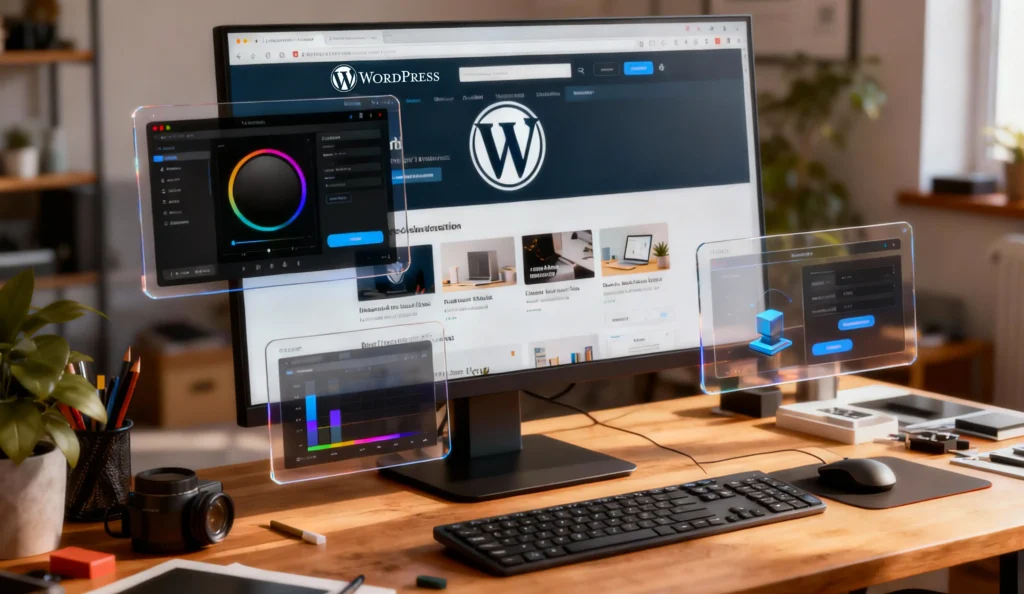
Lightweight, block-based, and performance-oriented themes are the go-to in 2026. They support modern design, clean code, and flexible layouts without bloating your site. Many trends lean toward block themes and no-code building experiences that still keep speed as a priority.
Avoid themes packed with 200 sliders, 50 animations, and a kitchen sink of features you’ll never use.
Plugins that actually matter
You don’t need 40 plugins – you need the right ones. A typical 2026 blogging stack might include:
-
SEO plugin for on-page and schema markup
-
Performance/caching plugin
-
Security and backup tools
-
Image optimization
-
Optional: AI-assisted tools for suggestions, internal links, and minor automations
The key is minimalism: fewer plugins, better quality, and regular updates to reduce conflicts and security risks.
Design & UX: your blog has to feel fast, clear, and human
Design trends that matter (not just aesthetics)
Modern WordPress sites lean into:
-
Minimalist, distraction-free layouts guided by AI-inspired clarity – one primary action per screen.
-
Dynamic typography that communicates personality and supports storytelling.
-
Micro-interactions and smooth transitions that make browsing feel intuitive instead of clunky.
Your blog doesn’t need to look like a design agency’s portfolio, but it can’t feel outdated either. Think “clean, confident, and focused,” not “messy magazine from 2010.”
Speed and performance
In 2026, performance is a ranking signal and a user patience test. Users expect fast loading even on slower connections, and edge + serverless architectures help deliver that.
A few basics still rule:
-
Compress images
-
Use caching and a quality host
-
Avoid bloated plugins and heavy scripts
-
Test on mobile frequently

Fast sites convert, slow ones bounce. Simple as that.
Monetization: how WordPress blogs make money in 2026
Let’s be honest – “passive income” posts made blogging sound like a magic ATM. In reality, a good WordPress blog is more like a digital asset that grows over time if you feed it well.
Common monetization paths:
-
Display ads (AdSense, premium networks) once traffic scales
-
Affiliate marketing with honest, experience-based recommendations
-
Digital products: ebooks, templates, checklists, tools, mini-courses
-
Services: consulting, coaching, audits, done-for-you setups
-
Sponsored content and partnerships once your niche authority grows
Diversification is the name of the game. In 2026, relying purely on ad revenue is risky; pairing it with products and services makes your income more stable.
LSI keywords and SEO without looking like a robot
Search engines in 2026 understand context far better, so “LSI keywords” are really about covering related concepts and questions naturally.
For a topic like “WordPress blogging in 2026,” natural related phrases might include:
-
best WordPress themes for blogging
-
is blogging still profitable
-
how to start a WordPress blog
-
WordPress SEO for beginners
-
content strategy for blogs
-
voice search optimization
The trick: write as if you’re explaining the topic to a curious friend, and those related terms will appear without forcing them.

FAQs: quick answers for Featured Snippets
Is WordPress still good for blogging in 2026?
Yes, WordPress is still one of the best platforms for blogging in 2026 because it offers flexibility, ownership, modern design options, and strong support for SEO, performance, and monetization.
Is blogging still profitable in 2026?
Blogging is profitable in 2026 if you treat it like a real business: pick a strong niche, create high-quality content that solves specific problems, build authority over time, and use multiple monetization methods like ads, affiliates, and digital products.
Do I need coding skills to run a WordPress blog in 2026?
No, you don’t need coding skills thanks to block themes, visual builders, and no-code tools, although basic understanding of structure and SEO can help you customize and grow faster.
How many blog posts do I need to start getting traffic?
There’s no fixed number, but many successful blogs in competitive niches start to see consistent organic traffic after publishing and optimizing a focused cluster of 20–50 high-quality, search-intent-driven posts.
Is AI-generated content enough to rank in 2026?
Pure AI dumps are risky; search systems prefer content that shows real experience, unique perspectives, and clear value, so the best approach is to combine AI assistance with human insight, editing, and storytelling.
How to start (or revive) your WordPress blog in 2026
If you’re starting from scratch or reviving an old blog, a simple action plan could look like this:
-
Pick your niche and angle
Decide who you’re helping and what problem you’re solving, not just “I’ll write about everything.” -
Set up a clean, fast WordPress site
Choose a lightweight theme, a reputable host, essential plugins, and basic pages (About, Contact, Legal). -
Research 20–30 core topics
Use your own experience, forum questions, social media comments, and keyword tools to find what your audience actually cares about. -
Create pillar and cluster content
Publish in batches around themes instead of random posts – and internally link everything. -
Focus on UX and trust signals
Make your site easy to navigate, quick to load, and clearly “human” with your story, photo, and contact options. -
Monetize gradually
Start with basic affiliates and email collection, then layer in ads, products, or services as traffic grows.
Your turn: join the 2026 wave of smarter bloggers
If you’ve been overthinking whether to start or relaunch your WordPress blog, 2026 is actually a sweet spot: tools are better, competition is more serious (which filters out lazy players), and the audience is hungrier than ever for honest, practical content.
So, here’s the deal:
-
Got an existing blog? Audit it. Update your best posts, fix UX, and build topic clusters.
-
Starting fresh? Choose your niche this week and set up the site – even if it’s “ugly v1.” You can always polish later.
Drop a comment with your niche idea or current blog URL and what’s blocking you right now. Let’s brainstorm a 2026-ready game plan for your WordPress blogging journey together.